第1章
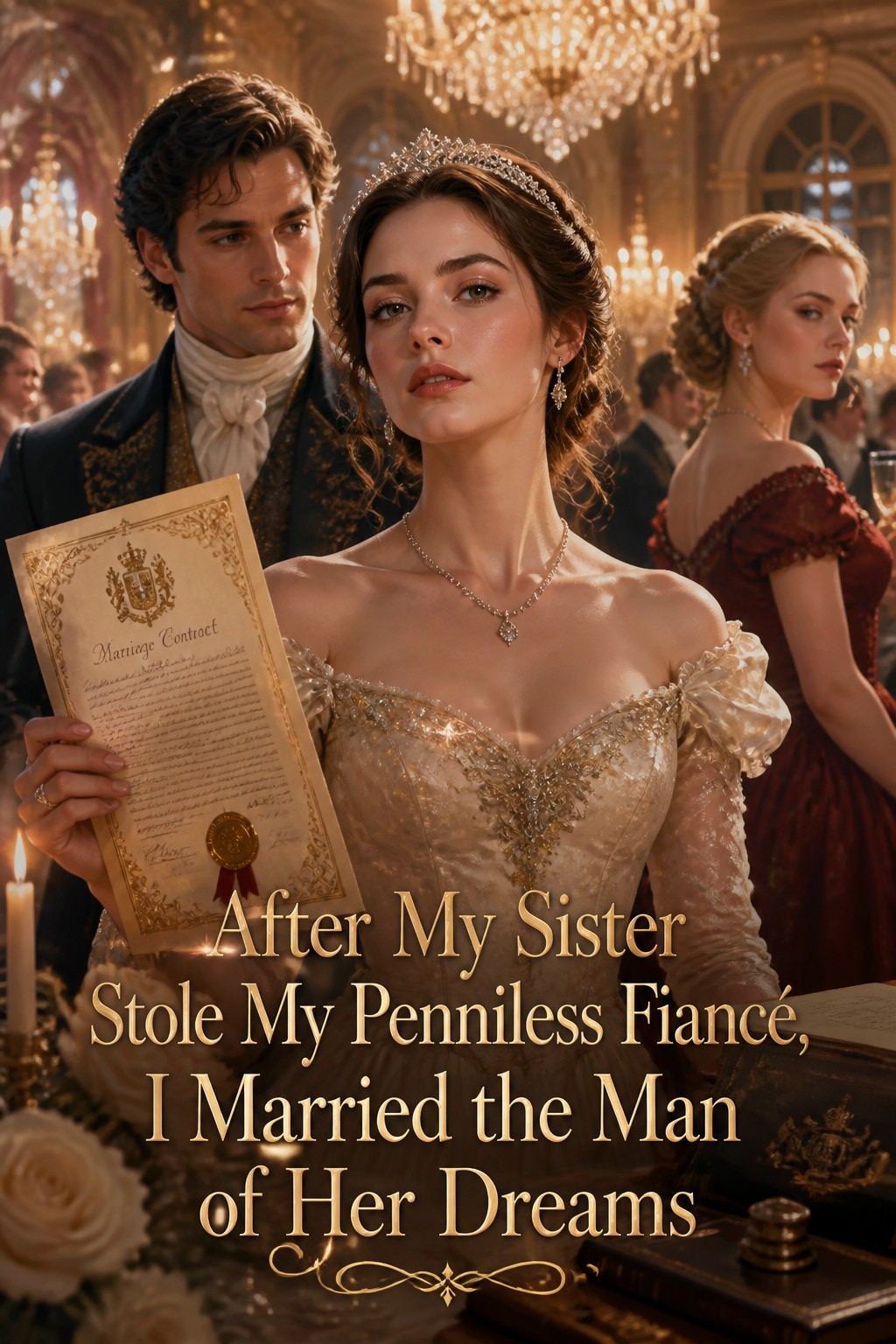
At the coming-of-age ceremony my sister and I shared at twenty-one, our father produced two marriage contracts.
One came from the ducal House of Beaumont. A century-old line with power beyond measure, whose heir Alexander was composed, wealthy, and the dream of every unmarried girl in Saint-Vérain.
The other came from the bankrupt Moreau family. Their estate mortgaged, creditors at the door, their heir Elias had nothing but a handsome face.
In my last life, my sister Vivienne chose Alexander first and left Elias to me.
Later, she was caught in an affair, and the Beaumont family confined her for life under the name of "psychiatric rest." Elias, with my help, climbed from ruined nobility into City Hall and became the youngest chief secretary to the mayor.
Vivienne didn't hate the in-laws who destroyed her, or the husband who was cold to her.
She hated only that I lived better than she did.
The day I visited her, she smashed my skull with a silver candlestick.
When I opened my eyes again, we were back at the moment of choosing.
Vivienne snatched the Moreau letter and said smugly, "Little sister, this time it's my turn to be the wife of the rising star of politics."
I looked at her and smiled.
She didn't know that in the last life, the one who had truly raised Elias to high office was never fate.
And that Alexander, who had never touched her, had never been cold by nature.
He had simply married the wrong woman.
Chapter 1
"I choose Elias Moreau."
Vivienne's hand pressed down hard on the gray contract.
The ballroom went silent at once.
Beneath the crystal chandeliers, the guests looked at one another. The Moreau family had declared bankruptcy three months earlier. The bank had seized their ancestral house, and even the carriage they had come in tonight was rented.
Father frowned. "Vivienne, are you sure?"
"Of course." She clutched the contract to her chest as if she were holding the future. "I love Elias. Poverty can't separate true love."
At the very back of the crowd, Elias raised his head. He still had the good looks of his youth from the last life, black hair slightly curled, melancholy eyes, an old dress suit that plainly didn't fit. Hearing himself chosen, he looked surprised first, then smiled with relief.
Only I saw the shrewd calculation beneath the smile.
He knew the Montreuil dowry was enough to pay off his debts.
As Vivienne passed me, she said in a voice only we could hear, "Camille, it's time you gave back the good fortune you enjoyed."
She had come back too.
It was the same look she'd had in the last life, swinging the candlestick at me.
"Little sister, I'll make a fine wife for the mayor's chief secretary on your behalf." She leaned close to my ear. "As for the Beaumont family's living corpse, he's all yours."
She thought Elias had risen because his talents had finally been recognized. She thought Alexander refused to touch her because he had no desire.
She didn't know that I had written Elias's first campaign speech, that I had brought in his first political donation, that I had filled three holes in his accounts that could each have destroyed him.
Still less did she know that after my death, Alexander had personally torn apart the lies the Beaumont family had woven around her and taken the estate where she was confined to court.
Father's voice broke into my thoughts. "Then Camille, will you accept the Beaumont contract?"
The crowd parted on its own.
Alexander de Beaumont stood at the far end of the long table. Twenty-eight, dark gray eyes, straight-backed, a royal medal on his chest. He was already the youngest legal counsel to Parliament and the sole heir of the ducal house.
In the last life, he had never once looked at Vivienne like this.
Now his gaze was fixed on my face, his knuckles white with restraint.
I suddenly remembered the year I was seventeen, when he had returned a book of poems to me in the rain. A dried white rose was pressed inside the flyleaf. I had taken it for mere courtesy.
Later I became engaged, and he went alone to the North for four years.
Some answers, it seemed, I hadn't understood even by the time I died.
I picked up the gilt-edged contract and walked to him.
"I accept."
Alexander's ever-composed eyes lit up all at once.
He didn't reach for the contract first. He took my hand and confirmed it in a low voice. "Camille, you chose me?"
"You."
His thumb brushed lightly across the back of my hand, as if touching a treasure lost and found again.
"Then," he bent and kissed my fingertips, "I will never let you regret it."
Chapter 2
After the ceremony, the Beaumont carriage waited at the door.
Alexander draped my coat over my shoulders himself. The September night wind had just risen, and his palm rested on my shoulder through the cashmere, without the slightest liberty.
"The contract can be dissolved," he said suddenly, once we were inside.
I looked at him.
"If you only wanted to avoid marrying Moreau, I can go along with it." He set a signed dissolution agreement in front of me. "The ducal house will take public responsibility, and your reputation won't suffer. You needn't be bound for life by one sentence spoken today."
In the last life, Vivienne often said he was controlling, cold, and rigid.
But on the first night he had truly chosen me, what he gave me was not jewels or rules. It was a way out.
I didn't take the agreement.
"You don't want to marry me?"
Alexander's breath stopped for an instant.
"I do." He answered too fast, then looked away. "It's because I do that I can't take advantage of a hasty decision."
I couldn't help smiling. "For how long?"
The carriage was dim, yet the tips of his ears slowly reddened.
"Eleven years."
When I was seven, in the palace garden, I had rescued a silent boy surrounded by noble children. I had long forgotten it. He had remembered for eleven years.
The book of poems at seventeen. The anonymous funding for my historic building restoration project at eighteen. And at nineteen, when Father was about to promise me to a widower of sixty, he pushed our two houses into drawing up a marriage contract.
But when the contracts arrived, Vivienne had chosen him first.
"Why, in the last life—" I almost blurted out, and caught myself.
"What?"
"Why, in all these years, did you never tell me?"
"You smiled when you looked at Elias." His voice was calm. "I thought that was love."
My chest ached. Back then I had only pitied the ruined Elias, and I was used to caring for anyone in a humiliating position.
Alexander had taken my kindness for a choice, and stepped back, for an entire lifetime.
The carriage stopped before the Beaumont residence. The white stone mansion blazed with light. On the steps stood the old Duke and Duchess and a dozen stewards.
Alexander stepped down and held out his hand to me.
"Grandmother has prepared a family dinner. She looks stern, but she won't hurt you." He lowered his voice. "If anyone makes you uncomfortable, look at me. I'll take you away."
"Including your grandmother?"
"Including the King."
I put my hand in his palm.
In the last life, when my sister married into this house, she arrived forty minutes late to the first dinner and complained that the Duchess's seating plan was old-fashioned. Alexander said nothing the whole time, and the dinner ended badly.
Tonight, I stepped into the dining room on time, addressed every elder by the correct title, and moved myself to the seat on the left of the old Duchess, who spoke little because her hearing was failing.
She looked at me. "You know sign language?"
I answered in the sign language of Saint-Vérain. "Only a little. I hope one day to understand everything you say."
The severity in the old woman's face eased a fraction.
Under the table, Alexander took my hand and didn't let go for a long time.
Chapter 3
The wedding was set for a month later.
Vivienne complained that Father was giving the Moreau family too small a dowry, and smashed cups and plates in the study.
"Camille gets three vineyards south of the city. Why do I only get one?"
Father explained wearily. "The Beaumont family doesn't accept cash dowries. Those three vineyards are only a nominal dowry. The title stays in the family trust. The Moreau debts have to be filled with real money."
"Then liquidate the trust!"
I stood outside the door and could almost picture how she had complained about the Beaumont rules in the last life. She had never cared how assets worked, only whose neck the jewels ended up on.
I knocked, went in, and laid the agreement I had prepared on Father's desk.
"My private trust will not guarantee the Moreau debts."
Vivienne spun around. "By what right?"
"By our maternal grandmother's will, which states that from twenty-one it is mine to manage."
In the last life, to pay off Elias's first round of debts, I had sold the winery my grandmother left me. This time, not one coin would flow into the Moreau bottomless pit.
Vivienne sneered. "Keep it if you can't bear to part with it. Elias will be in City Hall soon enough, and then you'll be begging us too late."
She left on her fiancé's arm. As Elias passed the desk, his eyes lingered on my trust agreement for two seconds.
That look told me for certain: he had already begun to regret being chosen by my sister.
My wedding was held in the Beaumont family chapel. It wasn't lavish enough to stir the whole country, but half of Parliament came. When we took our vows, Alexander's voice was more solemn than the priest's.
"In health or sickness, in honor or disgrace, I take you as my only family."
Those weren't the standard vows.
The priest paused. I looked into Alexander's eyes and answered, "And I, you."
The day after the wedding, the old Duchess set a ring of keys in front of me.
The silver vault, the wine cellar, the archive, the ballroom, and the sapphire seal that represented authority over the household.
"When Vivienne married in, I didn't give her these for three months." The old woman was blunt. "She couldn't remember the stewards' names, and she wouldn't read the ledgers. You've been here one month, and you've already cut three duplicate expenses on the estate, corrected the winter relief list, and had the kitchen prepare separate meals for twelve servants with allergies."
I froze. She remembered the last life too?
"Don't be nervous." The old woman pushed the keys toward me. "I'm speaking of how I imagine the other choice would have turned out. How a woman treats a waiter at a banquet is enough to tell how she'll manage a household."
I took the keys. "You aren't afraid I'll seize power?"
"A house is not a throne. Whoever can make it run should hold the authority."
She looked toward the door. "Besides, someone asks me three times a day when I'll hand the keys to you."
Alexander stood there, his expression unchanged. "Grandmother, twice."
"The one before breakfast doesn't count?"
The tips of his ears went red again.
I lowered my head and smiled. The old Duchess tapped her cane. "Camille, the keys are yours. As for this hopeless grandson of mine, I'm handing him to you along with them."
The first crisis after the handover came sooner than I expected.
The ducal house's winter payroll was short twenty-seven thousand crowns. The head steward insisted it was a calculation error, while three stewards from the collateral branches told the same story: the shortfall came from servants' medical expenses.
I didn't lose my temper in public. I only had the pharmacy receipts from the past five years brought in.
The same fever medicine was priced in the house ledgers at six times the market rate. Of the eight servants supposedly under long-term treatment, two were dead and three had never existed.
The head steward knelt and begged me to protect the old Duke's reputation.
"The Beaumont name should not be upheld by covering up theft." I had the lawyer call the police and put the recovered money into the servants' pension fund.
That night, the stewards of the kitchen, the stables, and the laundry signed the last page of the ledger of their own accord, agreeing to the new audit system. The old Duchess didn't praise me. She only sent the register of appointments and dismissals, which she had always kept herself, into my study.
When Alexander came home, I was bent over the desk checking the last page.
"Everyone says you handled it very well."
"Some say I was too harsh."
"The one who stole Grandmother's seal will say tomorrow that prison is too cold."
He wrapped his arms around me from behind and rested his chin on my shoulder. "Camille, you don't need everyone to like you. The house gave you authority so you wouldn't have to go on being the good daughter who pleases everyone."
My pen stopped.
In the last life, what I did best was satisfy everyone. I cleaned up after my husband, cared for my sister on my parents' behalf, bore my sister's resentment. Until the day I died, I believed that if I was just a little more understanding, someone would finally see my worth.
Alexander was telling me I didn't have to please anyone.
I turned and held him.
"What is it?" He tensed at once.
"Nothing. I just suddenly wanted to hold you."
He was quiet for two seconds, then gathered me tighter. "Then you can be sudden a little longer."
Chapter 4
In the last life, six months into her marriage, Vivienne had smashed a wineglass in front of me.
"Alexander isn't a man at all." She spoke through clenched teeth. "He won't touch me. He won't even enter my bedroom."
At the time I thought the political marriage had made them both unhappy.
Until my own wedding night.
Only one lamp was lit in the bedroom. Alexander removed the ornaments from my hair, his fingers trembling with restraint.
"Camille." Every time he came closer, he asked first. "May I?"
Only when I nodded did he kiss me.
This man, who could leave the opposition speechless in a parliamentary debate, stopped halfway through the kiss and pressed his forehead to my shoulder to steady his breathing.
"Do you regret it?" I asked.
"I'm afraid it's a dream."
"Then do something you wouldn't dare in a dream."
He looked up at me, his gray eyes dark as the sea before a storm.
Only later did I understand that his so-called lack of desire was simply a refusal to touch a woman he didn't love. Once he had truly married me, he would gladly have canceled every banquet and moved the parliamentary papers into the bedroom.
When I woke in the morning, he was already dressed and sitting on the edge of the bed, watching me.
"How long have you been watching?"
"Three minutes."
Outside the door, his valet coughed. "Forty minutes, my lord."
Alexander closed the door without a flicker of expression.
On the third day of our marriage, he handed me his salary account, his private investments, and the list of the ducal house's shareholdings.
"You're not keeping any money of your own?"
"I can apply for an allowance each month."
"Apply to whom?"
"To you."
He said it as if it were the most natural thing in the world. At last I understood what the old Duchess had meant when she called him "hopeless" that day.
The sweetness didn't make me forget what had to be done. The Beaumont family looked glorious, but a third of its income was dragged down by aging industries, and three uncles from the collateral branches were laundering their own accounts through the charitable fund.
I spent two weeks putting together a risk report, proposing the sale of the loss-making shipping shares, more investment in the new-energy railway, and a third-party audit of the fund.
At the family council, the second uncle sneered. "A new bride shouldn't meddle in men's business."
Alexander closed the file.
"She holds the family seal. Her opinion is my opinion."
"You question your elders for a woman?"
"No." I opened the appendix. "The audit evidence is questioning you."
When the council ended, the uncle was suspended from his duties. The old Duchess announced in front of everyone that from then on I would chair the monthly joint meeting on household and assets.
Leaving the council room, Alexander suddenly pulled me into an empty corridor and kissed my forehead.
"You kept looking at me in there," I said.
"My wife is very beautiful."
"Just beautiful?"
"Clever, brave, dazzling." He added seriously, "Beautiful comes last."
In the last life, every time Elias succeeded, he said he had seized his opportunity.
In this life, Alexander simply draped my coat over my shoulders and told everyone, "She had the ability all along. My only job is to stay out of her way."
For the first time I understood that being loved is not being kept.
It is having someone see your wings and still be willing to open the window for you.
At the palace banquet half a month later, I made my first public appearance as Lady Beaumont.
Before we left, Alexander waited outside the dressing room for an hour. When the maid opened the door, he looked at me and forgot to stand up.
"Not good?" I asked deliberately.
"I'm considering feigning illness."
"Why?"
"So that no one else could see you."
He added at once, "Only considering. I know you're not my possession."
At the banquet, sure enough, a young diplomat asked me to dance. Alexander stood not far off, his face calm, the wine in his hand untouched.
I accepted the first dance out of courtesy, and for the second walked straight to him.
"Would His Grace do me the honor?"
"You needn't look after my feelings."
"I want to dance with my husband. Is that not allowed?"
The restraint in his eyes melted all at once.
The music began. He placed his hand at my waist, at first keeping the distance etiquette required. When we turned into the shadow of the terrace, I moved half a step closer on my own.
"You're jealous."
"A little."
"How much is a little?"
"Enough to want the orchestra to end the banquet early."
I laughed out loud. He laughed too, with an ease very few people had ever seen.
Across the room, Vivienne was watching us. In the last life she complained that Alexander never danced with her, but she never mentioned that whenever he asked, she deliberately left him waiting in the middle of the floor so her admirers could fight over her.
Love can be partial, but dignity cannot be maintained by one side alone.
When the dance ended, Alexander kissed my forehead in front of everyone. The next day every newspaper carried the photograph, saying the stern Beaumont heir had finally learned to smile.
He cut out the article and put it with my first advisory invitation.
"How many things about me have you collected, exactly?"
"Not many."
Later I discovered in his private safe that "not many" included the thank-you card I had written him at seven, the bookmark I had lost at seventeen, every one of my committee reports, and the menus I scribbled for the kitchen.
The safe's combination was the date we met again.
This man hadn't suddenly turned lovesick.
He had simply, at last, placed eleven years of hidden love in my hands.
Chapter 5
On Vivienne's wedding day, the Moreau creditors blocked the church doors.
She had to use half her dowry to redeem the ancestral house and the other half to repay loan sharks. The wedding banquet was only six tables, and the family crest on the silverware had worn smooth.
Yet she raised her chin and told me, "It's only temporary. Wait and see how Elias rises."
I answered sincerely, "Then you'd better work hard."
In the last life, two months after her wedding, I found that the old-town redevelopment hearings were publicly recruiting recorders. Elias thought the post beneath him and refused to apply. I wrote the application for him and urged him to learn every faction's interests from the minutes.
This time, sure enough, he didn't go.
He slept until noon every day, claiming to be waiting for an opportunity worthy of the Moreau name. Vivienne was even more confident than he was. She sent a letter of recommendation straight to the mayor's office, signed "future chief secretary" in her own hand.
The letter went around City Hall as a joke.
A month later, Elias finally applied to be a councilman's aide. He had memorized the opening of the speech I wrote for him in the last life, couldn't remember the second half, and resorted to attacking the other candidates' origins on the spot.
The interviewer asked him to leave.
Vivienne stormed into the Beaumont house, certain I had interfered.
"You're afraid he'll succeed, aren't you?" She stood in the middle of the drawing room. "You're jealous that I'll have the life you had last time!"
I set down my teacup. "What was the topic of the speech?"
She stiffened.
"What is the old town's winter heating budget? Which party does the councilman belong to? What is his core platform?"
She couldn't answer one.
I looked at her. "You don't even know which road your husband means to take. What makes you think wealth and glory will knock on your door by themselves?"
"Elias has talent!"
"His talent is calling other people's work his own luck."
Footsteps sounded outside. Alexander had come home early from a meeting, and the first thing he looked at was my expression.
"Has she been bullying you?"
Vivienne laughed in anger. "She's the one bullying me. Alexander, do you know she's had my husband in her heart all along?"
The air went cold.
Alexander came to my side, but instead of questioning me, he only took my hand. "I believe only what Camille tells me herself."
I looked at him. "I don't love Elias. I didn't in the past, I don't now, and I never will."
His fingers tightened at once, and he couldn't hold back his smile.
Vivienne's face soured. "You trust her just like that?"
"Yes."
"And if she's lying to you?"
"Then I'm willing to be."
He rang for the butler to see her out, then bent and kissed me in front of my sister.
"The meeting ran three hours." His voice was low, but the grievance in it was unmistakable. "I missed you."
Vivienne slammed the door on her way out.
I gave him a push. "You did that on purpose?"
"Half."
"And the other half?"
"I really missed you."
Chapter 6
The winter charity ball was the first public test of the new mistress of the House of Beaumont.
The guest list, the seating, the menu, the security, and the grants to four charities were all mine to handle. In the last life, Vivienne found it tedious and pushed all of it onto the butler. In the end two political enemies were seated at the same table, and a Jewish councilman was served a dish that broke his dietary laws.
This time, I checked every restriction a month in advance, placed feuding families in the east and west halls, and turned the budget for showy fireworks into winter coats for veterans.
On the night of the ball, the Queen Mother took my hand and said, "The Beaumont family hasn't held such a comfortable gathering in many years."
The old Duchess yielded me the seat at her right hand at the head table, in front of everyone.
As the applause rose, I saw Vivienne standing in a corner, her nails nearly cutting into her palms.
Her gown was expensive but didn't fit. To keep up appearances, she had mortgaged the Moreau ancestral house for another loan. Elias spent the whole night weaving among the councilmen, handing out cards to everyone he met, only to get three people's titles wrong.
Halfway through the wine, he set his sights on Mayor Grant.
"Your Honor, I've studied your old-town plan closely."
The mayor asked mildly, "What most needs solving first?"
Elias looked at me.
In the last life, at moments like this, I would drift over with a glass of wine and supply the answer for him in a single sentence.
Instead I took Alexander's arm, turned, and began discussing the Beaumont fund's new projects with the Queen Mother.
Elias stammered for a long while and said the opera house should be built first.
The mayor's face fell. Seven old people had frozen to death in the old town that winter.
After the ball, Alexander handed me a document in the carriage. The city government was forming a special committee on heating, and the mayor was inviting me to serve as an unpaid advisor.
"You recommended me?"
"I only passed him your report," he said. "The decision was his."
I looked at the invitation, and my chest felt warm in a way it hadn't for a long time.
In the last life, every report I wrote ended with Elias's name on it. I stood behind him, believing husband and wife should share honor and disgrace. But the first thing he did after his promotion was ask me to resign from the foundation, so no one would discover how much he relied on his wife.
Now, for the first time, my own name was printed openly on an official government letter.
Alexander turned his head. "You're not happy?"
"Very happy."
"Then why are you crying?"
Only then did I realize the tears had fallen.
He wiped them away with his cuff in a panic, so clumsy that he looked nothing like the Beaumont heir who could handle anything.
I took his hand. "Alexander, thank you."
"Don't thank me." He kissed the tears from the corner of my eye. "You only need to promise me one thing."
"What?"
"From now on, never give away credit that belongs to you, to anyone. Including me."
Chapter 7
After I joined the heating committee, I slept only five hours a night.
Visiting sites, calculating budgets, persuading the energy companies to cut their prices, converting the Beaumont family's idle warehouses into emergency warming shelters. Alexander didn't urge me to give it up. He only moved his desk next to mine.
I read the data, he reviewed the bills. When I forgot to eat, he held the spoon to my lips.
At two in the morning, I woke slumped over the desk with his coat over my shoulders. Snow was falling outside, and he was still proofreading my forty-seven-page report.
"Aren't you due in Parliament in the morning?"
"I can sleep late."
"If the ducal heir drops dead in his study, the papers will blame me."
"Then kiss me once and I'll go to bed."
I thought he was joking and brushed my lips against his cheek. He shut the file at once. "Done."
He walked to the door, came back, and lifted me up, blanket and all.
"What are you doing?"
"The agreement said I'd go to bed. It didn't say I couldn't take you with me."
The heating plan passed by an overwhelming vote. The mayor thanked me publicly at the press conference, and the papers called me "the one who taught the old nobility responsibility again."
The same day, the Moreau house had its water and power cut off.
Vivienne rushed to demand why Elias hadn't paid the bills, and found he had taken their last cash to the casino.
The two of them fought at the door. For the first time, Elias shoved her.
When the news reached me, I was silent for a long time.
Vivienne had killed me once, but that still didn't give any man the right to raise a hand to her. I had the lawyer send her, anonymously, the procedure for applying for a protection order and the address of a temporary shelter.
She tore the papers up, and the next day she appeared at a banquet with Elias on her arm, showing off their marital bliss.
"He's just under too much pressure." She stopped me. "It's normal for a man to have a temper. Once he's the mayor's secretary, everything will be fine."
"He can't even pay the water bill."
"That's because you stole his chance!"
She was convinced that life was a wishing well. Toss the right man into a marriage, and power and wealth would pour out on their own.
I reminded her, "The mayor's office is openly recruiting policy researchers next week. If you truly believe in him, have him prepare for the exam."
"Since when are you so kind?"
"The notice is on the official website. Anyone can see it."
Elias did register, then dumped all the preparation on Vivienne. In the last life she had seen only her husband's title and never learned my work, so all she could do was pay a ghostwriter.
On the day of the written exam, the questions were changed at the last minute.
He handed in a blank paper.
At home, he blamed the failure entirely on Vivienne. The neighbors heard things breaking and her screaming, and called the police.
Facing the officers, Vivienne insisted she had accidentally walked into a door.
She would rather be covered in bruises than admit that what she had snatched wasn't gold.

 GoodNovel
Completed